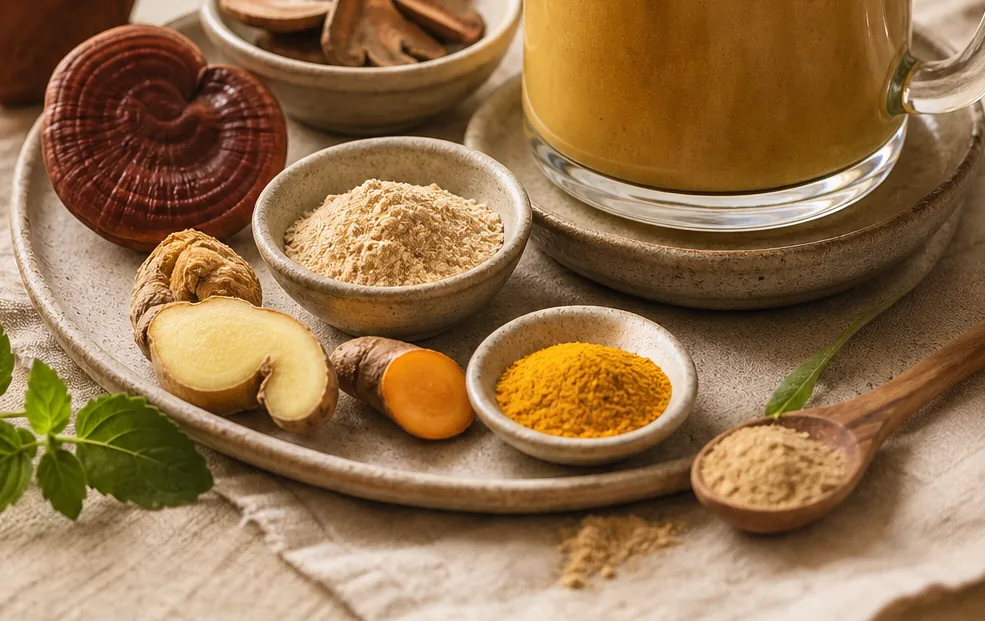
The front of a canned drink might promise calm, focus, or balance beside a drawing of a leaf. Turn it around and the details get more complicated: botanical extracts, milligrams, a “proprietary blend,” and possibly caffeine from ingredients that do not look like coffee.
Before asking what the drink promises to do, find out what it actually contains. The word adaptogenic is a marketing and herbal-use term, not a special FDA safety rating or proof that a finished drink works. Two products with similar front labels may have very different ingredients, amounts, and directions.
This U.S.-focused guide gives you a practical reading order. It is not a recommendation to take an adaptogen, a dosing guide, or a substitute for advice about medicines or health conditions.
The 60-Second Label Check
| Start here | Look for | Why it matters |
|---|---|---|
| 1. Product identity | Is it presented as a conventional beverage or a dietary supplement? | The labeling rules and intended use can differ. |
| 2. Facts panel and serving | Nutrition Facts or Supplement Facts; serving size; servings per container | Numbers may describe one serving, not the whole bottle. |
| 3. Actual ingredients | Botanical names, plant parts, extracts, proprietary blends | “Adaptogen blend” does not tell you what each ingredient contributes. |
| 4. What else is in it | Caffeine sources, added sugars, other stimulants, warnings | A calming-looking package can still contain caffeine or ingredients unsuitable for you. |
| 5. Claims and quality evidence | Specific promises, testing seals, company contact details | A slogan or testing logo is not proof of a health benefit. |
If you cannot identify the ingredients or understand the directions, it is reasonable to put the product back and choose a simpler drink.
1. Is It a Beverage or a Dietary Supplement?
A conventional ready-to-drink beverage generally displays Nutrition Facts, subject to labeling rules and exemptions; a product legitimately marketed as a dietary supplement generally uses Supplement Facts. These panels are important clues but do not independently determine whether a product is legally classified correctly. FDA guidance recognizes that some liquid supplements can look like beverages, so the full presentation and intended use matter—not just the shape of the bottle.
| Label feature | Conventional beverage | Dietary supplement |
|---|---|---|
| Typical panel | Nutrition Facts | Supplement Facts |
| What to look at first | Serving size, calories, added sugars, full ingredients | Serving size, dietary ingredients and amounts, other ingredients, warnings |
| Botanical information | Usually in the ingredient list; individual botanical milligrams may not be given | Dietary ingredients generally appear in Supplement Facts; botanical plant parts and amounts have specific labeling rules |
| What the panel does not prove | That every botanical is safe or every claim is established | That FDA approved the product for safety or effectiveness before sale |
A Facts panel is a source of information, not an endorsement by FDA. If the package is confusing about whether it is a beverage or supplement, do not assume the label category resolves every regulatory or safety question.
2. Read Serving Size Before You Read the Big Numbers
A number printed on a bottle may apply to one serving, not everything in the package. Check both Serving Size and Servings Per Container, and look for any per-container information printed alongside per-serving figures.
Here is a fictional arithmetic example, not a reproduction of a legally approved label: a resealable 24-fl-oz drink lists two 12-fl-oz servings, each with 8 grams of added sugars. Drinking the entire bottle means consuming 16 grams of added sugars. A real package may also show a separate per-container column.
For a supplement, an ingredient amount in Supplement Facts generally describes the labeled serving. Do not treat “per serving” as the same as “per bottle,” and do not take extra servings merely because a marketing statement sounds appealing. The directions and your personal circumstances still matter.
Two Simplified, Fictional Labels: What Would You Notice?
The following are teaching examples only, not photographs of products, a model of FDA-compliant label design, or an endorsement of any ingredient. They deliberately omit details that a real regulated label might need.
| Fictional Product A — conventional drink | Fictional Product B — labeled dietary supplement |
|---|---|
| Nutrition Facts: Serving size 12 fl oz; 2 servings in bottle; Added sugars 8 g per serving | Supplement Facts: Serving size 1 fl oz; Botanical proprietary blend 450 mg per serving |
| Ingredients (excerpt): Water, fruit juice, sugar, botanical flavors | Blend ingredients (example only): Ashwagandha root extract, reishi extract, cinnamon (individual blend weights not displayed) |
| Question: If you consume the full bottle, what total added sugar does the per-serving panel imply? 16 g in this simplified arithmetic illustration. | Question: Does 450 mg mean 450 mg of each ingredient? No—it is shown here as the total blend weight. |
These are intentionally incomplete labels used to practice reading serving size and blend totals. A real Supplement Facts panel has detailed presentation and ingredient-declaration rules, and a liquid product's legal classification depends on how it is represented and used, not merely whether a certain panel appears. Check the actual package and official FDA guidance.
3. Identify the Botanical, the Plant Part, and the Form
Specific names matter more than a front-of-package list of benefits. For a botanical supplement, look for the common or scientific name and the plant part. The same plant can yield products from different parts, and the same name can appear on a plain food powder or a concentrated extract.
For example, a label might identify ashwagandha (Withania somnifera) root extract rather than simply “ashwagandha.” Reishi products may distinguish a mushroom fruiting body from mycelium or another preparation. “Turmeric” in a kitchen drink is not automatically the same product as a standardized curcumin supplement. These distinctions do not, by themselves, make one version better or safe for you; they tell you what questions to ask.
If all you see is mushroom complex or botanical matrix, look for a complete ingredient declaration elsewhere on the package. A scientific-sounding blend name is not a plant identity.
4. What Does “Proprietary Blend 450 mg” Actually Reveal?
In a dietary supplement, a proprietary blend can list several dietary ingredients under one combined weight. Under FDA dietary supplement labeling rules, the qualifying dietary ingredients in that blend must be identified, generally in descending order by weight, and its total weight declared; individual amounts within the proprietary blend need not be disclosed. Some types of dietary ingredients with established Daily Values must be declared separately under the applicable rules.
Imagine a hypothetical Supplement Facts entry:
Botanical Blend — 450 mg per serving
Ashwagandha root extract; reishi mushroom extract; cinnamon
This means 450 mg for the listed blend together, not 450 mg of each ingredient. You cannot tell from that entry exactly how much ashwagandha or reishi is present. The number is an illustration for reading labels, not a suggested serving.
For conventional beverages, the ingredient statement and applicable food-labeling requirements work differently, so do not assume every can must display the same Supplement Facts breakdown. If knowing the amount of a specific botanical matters to your decision and the label does not give it, ask the manufacturer or choose a product with clearer information.
5. Don't Turn Extract Ratios Into Homemade Doses
You may see 10:1 extract, standardized to 5% withanolides, or similar technical wording. An extract ratio describes aspects of the starting material and extraction yield. Standardization refers to a specified constituent or marker in a product. Neither is a universal scale of “strength,” clinical effectiveness, or safety.
A 10:1 extract is not automatically ten times as effective as the unextracted plant, and a teaspoon of powdered extract is not interchangeable with a teaspoon of ground kitchen spice. Solvent, plant part, manufacturing process, and finished composition can differ substantially.
The same caution applies to high-absorption formulations. For example, NCCIH reports liver-injury concerns involving some highly bioavailable curcumin supplements. An attractive claim about absorption is a reason to read more closely—not to improvise a drink recipe with a concentrated product.
6. Check Caffeine and Added Sugars Separately
A can labeled calm, daily ritual, or plant-powered may still contain caffeine. Look for coffee, black or green tea, matcha, yerba mate, guarana, and cacao or cocoa. These ingredients do not all contribute the same amount, but they deserve a closer look if you are limiting caffeine.
FDA says added caffeine used as a stand-alone ingredient must be declared in the ingredient list of packaged foods. Naturally occurring caffeine does not have to appear by the name “caffeine” when it comes from an ingredient such as tea or cocoa, and the total milligrams are not always printed. If you cannot find a quantity and it matters to you, contact the manufacturer. Decaffeinated is not the same as caffeine-free.
For conventional drinks, check the Added Sugars line in Nutrition Facts as well as the serving size. A botanical drink can be sweetened with cane sugar, syrup, honey, or juice-based ingredients. For supplements, read any applicable nutrition information and the complete other-ingredient list. “Natural” and “plant-based” do not mean unsweetened.
7. Treat Health Claims as Questions, Not Answers
Supports stress response. Promotes calm. Enhances focus. These phrases can be meaningful marketing messages, but they do not establish that the finished drink has been shown to deliver the promised result. Evidence about one ingredient, dose, or extract does not automatically transfer to another product containing a blend.
Under FDA rules, certain structure/function claims on dietary supplements require a disclaimer explaining that the statements have not been evaluated by FDA and that the product is not intended to diagnose, treat, cure, or prevent disease. That disclaimer is not a sign of FDA approval or proof of efficacy. It is also not a standard statement that belongs on every conventional beverage.
The FTC expects objective health-related advertising claims to be truthful, nonmisleading, and supported by competent and reliable scientific evidence. Ask whether a brand is offering evidence for its specific finished product or merely pointing to unrelated studies about one botanical. Testimonials and before-and-after stories are not substitutes for reliable evidence.
8. Read Warnings and Testing Claims Before Buying
The strongest reason to scrutinize a label may be the ingredient-specific cautions. For example:
- Ashwagandha: NCCIH advises avoiding it during pregnancy and breastfeeding and notes cautions involving thyroid or autoimmune disorders, surgery, certain medicines, and reported liver injury with some supplements.
- Reishi: Memorial Sloan Kettering warns of potential issues with blood thinners and immunosuppressants, as well as reported adverse effects.
- Concentrated curcumin: Some enhanced-absorption formulations have been associated with liver injury; they are not the same thing as ordinary culinary turmeric.
These examples are not an exhaustive interaction list, and a label cannot tell you whether a combination is suitable for your medical history. If you take medicines, are pregnant or breastfeeding, have an underlying condition, or are choosing a product for a child, ask a qualified clinician or pharmacist rather than relying on a sales page.
A label may also say third-party tested, USP Verified, or NSF certified. A genuine product-specific certification may describe particular identity, manufacturing, or contaminant checks within the program's scope; verify the exact product in the certifier's own directory before relying on the claim. It does not prove that the product works or is safe for everyone. Verify that a claimed seal applies to the exact product; a vague “lab tested” slogan without test details is less informative.
Look for a real company name and contact information. For supplement products, FDA requires manufacturer, packer, or distributor information and a domestic contact for reporting serious adverse events. If an important detail is missing or contradictory, do not fill the gap with guesswork.
A Simple Decision Before Checkout
You don't need to become an expert in every herb. You do need enough information to make an informed choice:
- Identify the product category and read the proper Facts panel.
- Check the actual serving, not just the front-of-can number.
- Find the named botanicals and product forms; question blends that hide useful amounts.
- Look for caffeine, sweeteners, interactions, and warnings.
- Separate marketing from substantiated evidence and verify any quality seal.
If those answers are unclear—or the product conflicts with advice from your healthcare team—skip it. A simple tea or familiar drink made from well-identified ingredients may suit your routine better than a complicated adaptogenic blend. The goal is to understand the label, not to collect more supplements.
Common Questions
Is an adaptogenic drink FDA-approved?
The word “adaptogenic” is not an FDA approval. FDA does not approve dietary supplements for safety and effectiveness before marketing. A conventional beverage is also not automatically approved for a claimed health effect because it has a Nutrition Facts panel.
What is the difference between Nutrition Facts and Supplement Facts?
Nutrition Facts is the familiar panel for conventional packaged foods and drinks; Supplement Facts is for products labeled as dietary supplements. FDA also looks at how a liquid product is represented and intended to be used, not only its container.
Does “proprietary blend 450 mg” mean 450 mg of each herb?
No. On a dietary supplement, that figure can represent the total amount of the blend per serving. Individual amounts for the dietary ingredients within a qualifying proprietary blend generally need not be listed.
Does a 10:1 extract mean it is ten times stronger or better?
No. The ratio describes the relationship between starting plant material and extract under a manufacturing process; it does not provide a universal comparison of effectiveness, serving size, or safety.
How can I tell whether an adaptogenic drink has caffeine?
Read the full ingredients for coffee, tea, matcha, yerba mate, guarana, and cocoa as well as separately added caffeine. Naturally occurring caffeine is not always declared by name or quantified. Contact the manufacturer if the amount matters and is not shown.
Does third-party testing prove an adaptogenic drink works?
No. A genuine verified testing seal may indicate certain quality checks within the program’s scope, but NIH ODS says these seals do not guarantee a product is safe or effective. Verify any claimed certification for the exact product.
Sources and Further Reading
- U.S. FDA — Questions and Answers on Dietary Supplements — Supplement product identity, required labeling, FDA premarket approval limits.
- U.S. FDA — Dietary Supplement Labeling Guide, Chapter IV — Serving sizes, plant parts, proprietary blend total quantities, extract declaration.
- U.S. FDA — Distinguishing Liquid Dietary Supplements From Beverages — Conventional beverages versus liquid supplements and labeling differences.
- U.S. FDA — Dietary Supplement Labeling Guide, Chapter VI: Claims — Structure/function claims and FDA disclaimers on dietary supplements.
- U.S. FDA — Spilling the Beans: How Much Caffeine Is Too Much? — Added versus naturally occurring caffeine and disclosure on packaged foods.
- U.S. FTC — Health Products Compliance Guidance — Requirement to substantiate objective health-related marketing claims.
- NIH Office of Dietary Supplements — Frequently Asked Questions — Third-party quality seals do not establish safety or effectiveness.
- NCCIH — Ashwagandha: Usefulness and Safety — Pregnancy, thyroid, autoimmune, surgery, medication, and liver-safety cautions.
- Memorial Sloan Kettering — Reishi Mushroom — Supplement risks, anticoagulants, immunosuppressants, and reported adverse effects.
- NCCIH — Turmeric: Usefulness and Safety — Highly bioavailable curcumin formulations and reported liver injury.
- Monagas et al. (2022) — Understanding Plant to Extract Ratios — Why botanical extraction ratios do not represent equivalent clinical effect or tea servings.